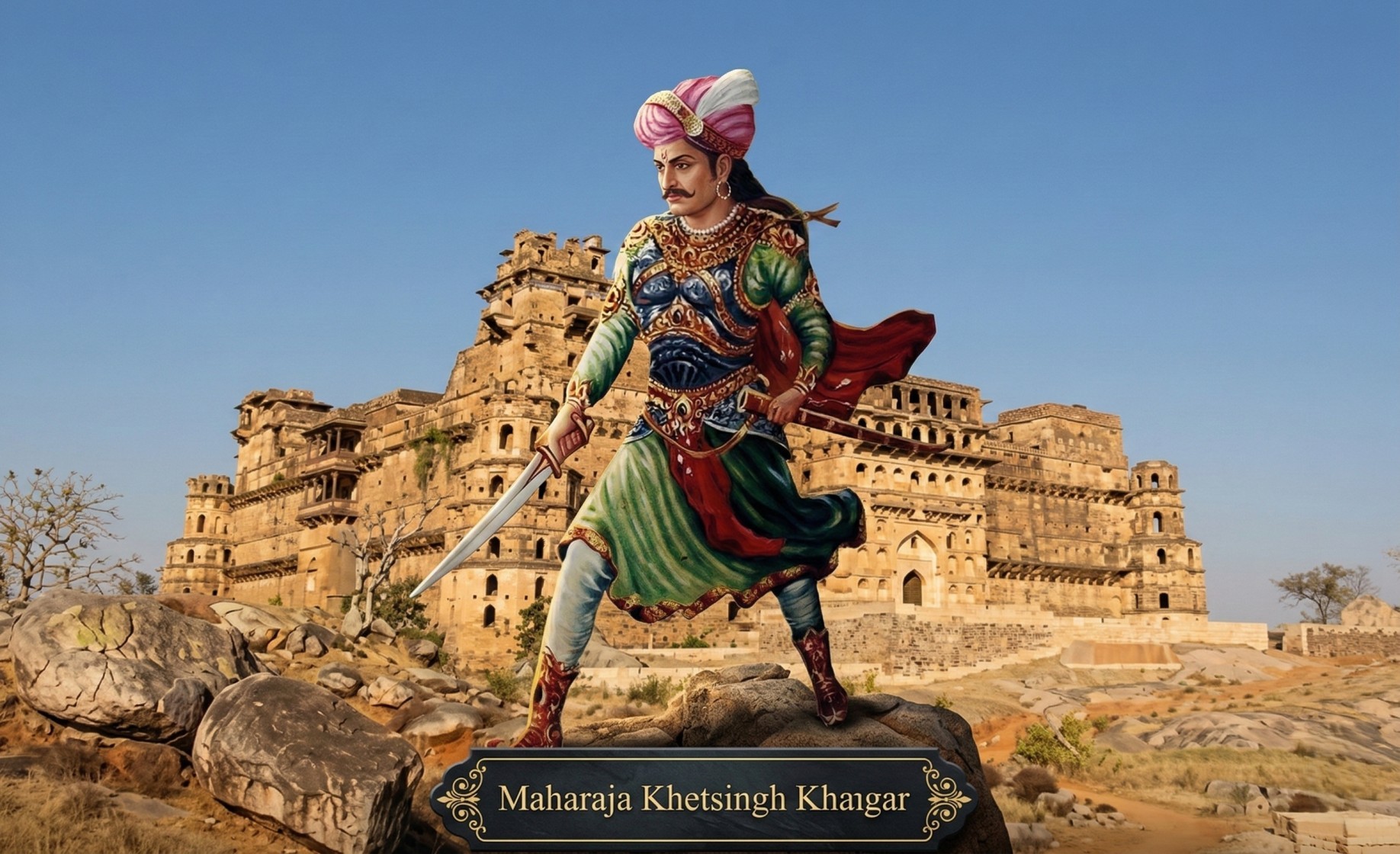
Maharaja Khetsingh Khangar stands among the distinguished Hindu Kshatriya rulers of medieval India. He is remembered as the founder of Jujhautikhand (present-day Bundelkhand) and a warrior of exceptional courage, leadership, and vision.
He was born on 27 December 1140 CE in Junagadh, Saurashtra (Gujarat) into a royal Kshatriya family. His father, Ra Katav II Rudradev, was the ruler of Junagadh, and his mother was Kishor Kunwar Bai. From an early age, Khetsingh displayed remarkable strength and skill in martial disciplines, particularly in swordsmanship.
A defining moment in his youth came when he confronted and defeated a lion. This act of bravery drew the attention of Emperor Prithviraj Chauhan, who later invited him to his court and honoured him with the title of “Singh.” This recognition established Khetsingh as a rising warrior among the leading Kshatriya nobles of his time.
Maharaja Khetsingh became a trusted ally and military commander under Prithviraj Chauhan. He fought alongside him in several campaigns, including the conflict in the region of Jejakabhukti around 1181 CE and the battle associated with Mahoba. His leadership in these engagements strengthened his standing as a capable and respected commander.
Following victory in these campaigns, Prithviraj Chauhan entrusted Khetsingh with the governance of the region. In 1181 CE, he was formally installed as ruler and established his authority over the territory, naming it Jujhautikhand and setting Garhkundar as its capital. Under his rule, the region emerged as a stable and organised centre of power.
The turning point came after the Second Battle of Tarain in 1192 CE, when Prithviraj Chauhan fell and northern India came under foreign control. In this period of upheaval, Maharaja Khetsingh asserted independence and declared Jujhautikhand a sovereign Hindu state, ensuring continuity of indigenous rule in the region.
Maharaja Khetsingh passed away in 1212 CE, leaving behind a strong and enduring legacy. His successors—Raja Nandpal, Raja Chhatrapal Singh, Raja Khubsingh, and Raja Mansingh Khangar—continued to govern the region for nearly 165 years, maintaining the authority and traditions established under his leadership.
Maharaja Khetsingh Khangar is remembered as a founder, warrior, and statesman, whose contributions shaped the political and cultural identity of Bundelkhand. His life reflects the enduring values of courage, duty, and sovereignty associated with the Kshatriya tradition.
Comments 0